What we race: Box Stock, Open 2WD, AAA, 2500, and F1 on Mini-Z
A plain-English primer on the MR-04 platform, the touring and formula classes we run, and how to pick a path.
Mini-Z racing is small-scale radio control with proper race-craft. The cars are roughly 1/27 to 1/28 scale, about the length of a TV remote, and run on indoor tracks where a small mistake costs real time. A well-prepared Mini-Z has adjustable suspension, tyres, accurate steering and enough speed to make clean driving matter.

At Tassie Mini-Z Club we keep the programme clear but not tiny: we run Box Stock and Open 2WD as our core MR-04 touring classes, plus AAA and 2500 as separate touring grids with their own published limits, and F1 when Formula Mini-Z is on the card. Box Stock is the spec class for standard Readyset-style cars. Open 2WD is the open modified MR-04 class. AAA and 2500 each answer “how fast and how free” on their own sheets — they are not interchangeable with Box Stock tech. F1 is open-wheel layout and rules, not the same body or setup questions as a tin-top tourer. Always check the event class list and round brief before you buy parts for a new class.
We race fortnightly in southern Tasmania, with the club centred around Hobart and the Huon Valley. The tone is community-run and family-friendly, but the racing is still racing. People help each other in the pits, then try to beat each other cleanly on track.
Why the MR-04
The MR-04 is Kyosho’s newer RWD Mini-Z chassis: lower centre of gravity, revised front geometry, and electronics aimed at today’s brushless and radio standards. For our club, it is the reference chassis for touring — what we expect new drivers to buy toward, and what Box Stock, Open 2WD, AAA, and 2500 briefs are usually written around (exact allowances still live in the published sheet for each round). F1 uses Formula-style hardware and bodies; bring the car that matches the F1 rules, not a touring shell by mistake.
The MR-04 did not appear in a vacuum. For well over a decade the MR-03 was the global default RWD Mini-Z. It introduced Kyosho’s dynamic strut front end and a compact steering servo layout, and it proved that a palm-sized car could reward precision: turn in cleanly, keep the rear settled, get back on the throttle without upsetting the car. The MR-04 carries that same philosophy forward with a more modern package.
The layout is still modular at the rear: the motor pod carries the motor and axle, while the rear of the chassis moves on a flexible T-plate and a top damper — the same “springy T-plate + top shock” idea that made the MR-03 so tuneable. That is why the same basic architecture can be a beginner Readyset, a tidy stock racer, or a serious modified build.
Parts, bodies and wheels are increasingly available for MR-04; many Auto Scale bodies that fit MR-03 need a quick fitment check on MR-04 (wheelbase and pod choice). If you break something on a race weekend, ask in the pits — someone has usually already fought the same part number.
Older MR-03 cars still turn up on the second-hand market and may remain eligible in some classes or club rounds depending on the published ruleset. If you already own an MR-03, bring it to tech and ask before assuming it matches the same Box Stock sheet as a new MR-04 Readyset.
Box Stock
Box Stock is the class most people should start with. The point is to keep the cars close enough that driving, preparation and race discipline matter more than the size of the parts order.
In plain terms, Box Stock means a Kyosho MR-04 RWD Readyset-style car running the standard motor and standard on-car electronics for that kit. It uses AAA NiMH batteries, not LiPo, unless the class sheet for a specific round says otherwise. The handheld is usually the bundled KT-531P, but Kyosho also supports Flysky Noble NB4 / NB4+ with the FS-RM005 Mini-Z/FHSS module while the car stays on its stock receiver/ESC — follow Kyosho’s firmware and binding instructions for that module. The chassis stays fundamentally standard: no aftermarket ESC swap in the car, no major hop-up chassis parts, and no clever motor work outside what the rules allow for that meet.
What can you change? The things that keep the car reliable and fair. Body choice is usually fine when it fits the MR-04 and does not create a rules problem. Tyres are the main tuning item, because stock tyres are rarely the best match for a club floor. Small service parts are normal: wheel nuts, body clips, replacement T-plates when one is damaged, and similar maintenance items. If in doubt, ask before you fit it.
The honest truth is that a fast Box Stock car is not magic. It is usually a straight car with good tyres, good batteries, a clean drivetrain and a driver who can run five minutes without panic. On a tight indoor track, corner speed beats peak speed. Most new drivers lose more time by braking too late, turning too sharply, or getting back on the throttle while the car is still loaded up than they lose through a lack of parts.
Box Stock suits newcomers, families, juniors, returning RC racers and experienced drivers who enjoy close racing. You can learn the racing line, marshalling, heat structure, battery routine and basic setup without needing a bench full of tools.
Open 2WD
Open 2WD is the modified MR-04 class (and MR-04 EVO builds where the rules allow). The car is still rear-wheel drive and still within the Mini-Z road-racing world, but the restrictions are much looser.
This is where you see ball differentials, tuned motor mounts, carbon or fibreglass T-plates, different front ends, upgraded bearings, brushless motors, EVO electronics, programmable throttle settings and more aggressive tyre choices. Depending on the event rules, Open 2WD may allow a wide range of MR-04–based parts and bodies. It does not mean all-wheel drive, and it does not mean bringing a completely unrelated scale or chassis because it happens to fit on the track.
Open 2WD suits people who like setup work. A modified car can be faster, but it is not automatically easier. More motor makes throttle control harder. More steering can create traction rolls. Softer rear tyres can make the car launch harder but also make it lazy or inconsistent. A powerful car with a poor setup will often be harder to drive than a clean Box Stock car.
If you are new, the best path is usually to race Box Stock first and watch Open 2WD, AAA, and 2500 mains when they are on the programme. You will learn what the faster cars are doing, which parts are common at our track, and which upgrades solve real problems rather than adding shiny weight.
AAA
AAA is its own touring class: not Box Stock, not generic Open. It is aimed at drivers who want a defined brushless / kit-style package (motor, ESC, and often battery choices) on MR-04-class hardware, with parity enforced by the sheet rather than by “anything goes.” The embedded walkthrough above is an example of the kind of build culture AAA sits in — still tyres, pod, and dampers, but different legal limits than Box Stock.
Treat AAA like a spec ladder: if the round lists AAA, read that brief end to end before you change motors, batteries, or radios. When in doubt, tech inspection before qualifying beats a protest after the tone.
2500
2500 is our brushless touring speed tier — a class band where motor and electronics limits are set so grids stay close without being as tight as Box Stock. The number refers to the rules band we publish for that meet (think “this much motor / this much freedom”), not a generic internet setup.
If you are coming from Box Stock, assume nothing transfers except driving skill and tyre discipline. If you are coming from Open 2WD, assume you cannot run full Open power unless the 2500 sheet for that night says you can. One car, one ruleset — ask the race director which sheet your chassis should meet.
F1
F1 is open-wheel Formula Mini-Z: different wheelbase, aero, and weight distribution from a tin-top MR-04 tourer. The racing is still Mini-Z indoor craft — clean lines, patience on throttle — but the limit of grip and the way the car rotates in slow corners will feel unfamiliar if you only know touring bodies.
We run F1 when it is on the published class list for the event. Bodies, tyres, and chassis family must match F1 rules for that round, not touring Open rules. If you want one car for “everything,” F1 is usually a second chassis, not a body swap on race morning.
MR-03 on the used market (helpful if you shop second-hand)
The MR-03 name still covers a huge slice of the used market, so listings stay confusing even though our club focus is MR-04.
MR-03 Sport and Sports 2 were entry-level Readyset lines: brushed cars with combined receiver/ESC boards and Kyosho radios. Later Readysets commonly use the KT-531P transmitter on Kyosho’s FHSS system.
MR-03 SP is a higher-spec or special-package brushed line — check actual electronics and hop-ups before calling it “stock.”
MR-03 VE and VE PRO moved the line into integrated brushless electronics — fast, but not the usual Box Stock starting point.
MR-03 EVO separates receiver from ESC/servo and takes a small module for Futaba, Sanwa, KO Propo or Flysky. EVO SP bundles premium parts — a strong Open 2WD base on either MR-03 or MR-04 depending on rules, but not a cheap date once you add radio, body, tyres and batteries.
If you are bargain hunting, a tidy used MR-03 can still be a way into the hobby — just confirm with tech before you assume it slots into the same Box Stock definition as a current MR-04 Readyset.
Electronics in Plain English
Older brushed MR-03 cars use small electronic switches called FETs to control motor power. In simple terms, a FET is the part of the board that handles the current going to the motor. In the old modified brushed days, racers sometimes “stacked” extra FETs on the board so it could survive hotter motors. It worked, but it involved delicate soldering and real risk.
Modern modified Mini-Z racing mostly avoids that problem by using brushless systems. A brushless ESC is built to control a brushless motor directly. It is more efficient, can be programmed more precisely, and is a better fit for Open 2WD, AAA, 2500, and F1 power levels where the rules allow brushless — each class still caps how much of that capability you may use. Sensored brushless systems can also feel smoother at low speed, which helps when you are trying to feed the throttle in rather than simply spinning the rear tyres.
Radio systems are the other half of the electronics question. ASF was Kyosho’s older 2.4 GHz Mini-Z radio protocol, used with compatible Kyosho and KO Propo transmitters. Later Readysets use Mini-Z FHSS from the bundled KT-531P — and Kyosho’s FS-RM005 module lets a Flysky Noble NB4 / NB4+ speak the same Mini-Z FHSS to the stock Readyset receiver without changing the car’s board. EVO is different: you fit a separate receiver module in the car and pair Futaba, Sanwa, KO Propo, Flysky, etc., which is the route for EVO chassis builds in Open, not a blanket requirement for “any” aftermarket transmitter on a Readyset.
For a newcomer, this means one simple thing: buy for the class. Box Stock: stock car electronics plus either the bundled KT-531P or a Kyosho-supported FHSS combo such as Noble + FS-RM005 if you want a nicer wheel without an EVO conversion. Open 2WD: full EVO receiver modules and high-end radios become common once you are chasing that path. AAA / 2500 / F1: follow the published sheet for that class — motor, ESC, battery chemistry, and radio requirements can differ from both Box Stock and Open.
What to Buy
Prices move around, especially in Australia where Mini-Z stock arrives in waves, so treat these as sensible tiers rather than exact shopping baskets.
Under AU$300: Look for a used Kyosho MR-04 or MR-03 RWD Readyset, or a discounted brushed Readyset. A tidy second-hand car from a club racer is often better than a mystery online bargain, because you can see it run and ask what has been changed. Budget for at least one spare set of AAA NiMH cells and a set of tyres. If the car is missing its transmitter, body clips, wheel nuts or battery cover, price that in before you call it cheap.
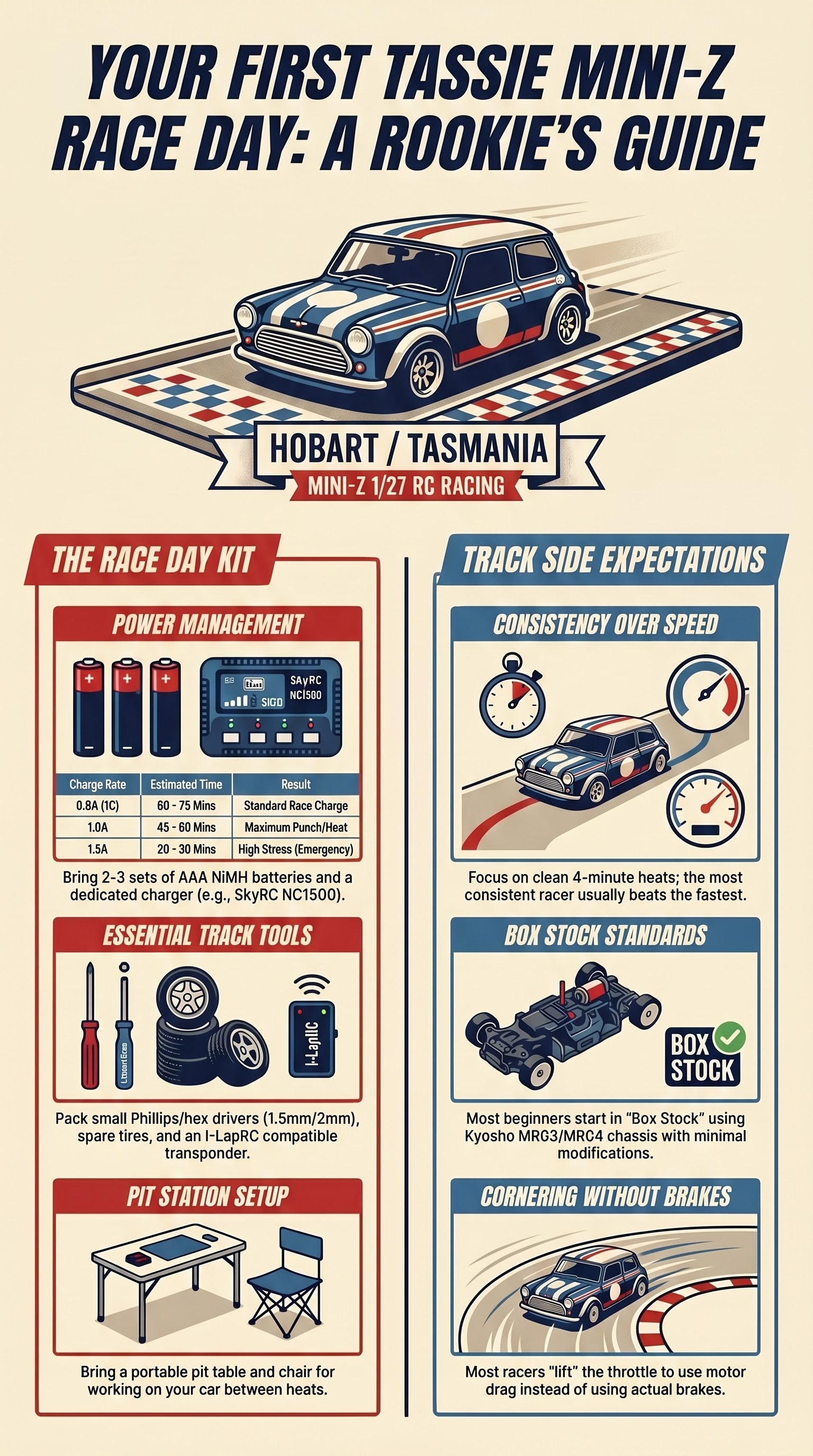
AU$300–600: This is the comfortable Box Stock tier. Aim for a clean MR-04 Readyset (or a known-good MR-03 if rules and budget line up), two or three sets of good AAA NiMH batteries, a smart charger such as a SkyRC NC1500 or iSDT N8, spare rear tyres, front tyres matched to the track, and basic tools. Panasonic Eneloop cells are a dependable starting point; racers may later try Kyosho Speed House, PN Racing, Team Orion or similar performance AAA cells. If the club timing setup requires your own transponder, include that in the budget.
AU$600 and up: This is where Open 2WD starts to make sense. A Kyosho MR-04 EVO or premium package can be a good base, but remember that a chassis set is not a complete car. You may still need a receiver module, compatible transmitter, body, wheels, tyres, batteries, charger, motor choices, springs, T-plates, differential parts and setup tools. A Flysky Noble NB4/NB4+ is popular because it offers strong features for the money, while Futaba, Sanwa and KO Propo remain common among long-time RC racers. Spend slowly here. It is very easy to buy a faster car than you can currently drive.
What You Need Beyond the Car
The car is only the centre of the kit. You also need a small race-weekend routine.
Bring spare AAA NiMH batteries. Two sets is the minimum; three is better if you are racing multiple heats. Label the sets so you can rotate them. A charger with independent slots is worth the money because one weak cell can make the whole car feel flat.
Ask about timing before your first event. Our race weekends use RC-Clubs for software and EasyLap for transponder-based lap counting. Transponders for our timing system are sold on the club shop when a listing is live—check there or ask the race director before buying a tag that might not match. Other venues may loan tags or expect you to bring your own; always match the system in use.
Bring simple body tools: small curved scissors or lexan scissors, a hobby knife, a body reamer, tape, spare clips and a small file. Even pre-painted Kyosho Auto Scale bodies sometimes need careful clearance around tyres, body mounts or wheel arches after a crash.
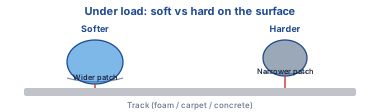
Tyres deserve attention. They are the biggest setup item on a Mini-Z. On prepared indoor surfaces, a common starting point is a harder front tyre and softer rear tyre: for example, around 30 shore at the front and 20 shore at the rear, depending on surface and body. Too much front grip can make the car flip or snap loose. Too little rear grip makes it slide on corner exit. Do not use traction compound unless the event rules explicitly allow it; most small-scale clubs ban it to protect the track surface.
Finally, bring patience. Mini-Z cars are small enough to race indoors, but they reward the same habits as larger RC cars: clean lines, calm throttle, straight preparation and respect for marshals.
Come and See It Run
If you are in Hobart, the Huon Valley or anywhere close enough for a fortnightly race day, the easiest next step is to come and watch a session. Check the events page for the next date, and use the event registration link when entries are open. Live timing, heats, and entries run through RC-Clubs; we also keep a LiveRC club page for some lap-by-lap views.
You do not need to arrive with the perfect car. Start with a rules-legal MR-04 Readyset (or confirm an older MR-03 with tech), ask questions, and build from there.